
Table of Contents
Fistula Tract Surgery in Hyderabad: Costs, Laser & LIFT Specialists
An anal fistula (fistula-in-ano) is an abnormal, epithelialized tunnel connecting an infected crypt gland inside the anal canal to an external opening on the perianal skin. Characterized by persistent pus discharge, localized swelling, throbbing pain, foul odor, and blood staining on undergarments, a fistula tract rarely resolves with oral medications or topical ointments alone. Because the tunnel is lined with chronic inflammatory tissue, physical closure or ablation of the infected tract is necessary to achieve a complete cure.
Historically, traditional fistula surgery (open fistulotomy) involved laying open the entire tunnel with a scalpel. When treating complex or high-lying fistulas that pass through major portions of the anal sphincter apparatus, cutting muscle fibers carries a high risk (15% to 35%) of causing irreversible gas or stool incontinence.
Today, modern proctology centers across Hyderabad prioritize sphincter-preserving, minimal-access procedures—such as FiLaC (Fistula-Tract Laser Closure), LIFT (Ligation of Intersphincteric Fistula Tract), and VAAFT (Video-Assisted Anal Fistula Treatment).
Leading surgical centers and laser proctology institutes across major healthcare hubs in Hyderabad—including Jubilee Hills, Banjara Hills, HITECH City, Gachibowli, Secunderabad, Begumpet, and Kukatpally—offer advanced Fistula Tract Surgery in Hyderabad. By combining 3D pelvic MRI Fistulography with high-precision diode lasers and video endoscopes, specialists eliminate infected tracts while keeping sphincter muscle function intact.
1. Classification & Anatomical Complexity of Fistula Tracts
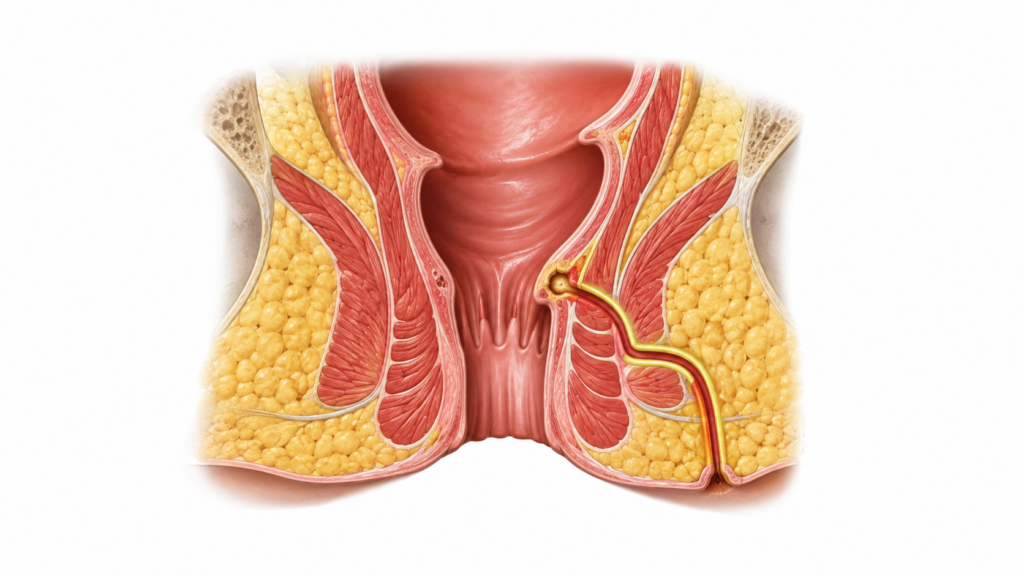
Fistula tracts originate from a clogged anal crypt gland at the dentate line inside the rectum. As infection progresses, pus burrows through pelvic tissue planes to create an exit point on the outer skin. Surgeons classify tracts based on their relationship to the internal and external anal sphincter muscles:
Parks Anatomical Classification of Anal Fistulas
- Intersphincteric Fistula (70% — Most Common): The tract remains confined between the internal and external sphincter muscles. It involves minimal muscle tissue and carries a low incontinence risk.
- Transsphincteric Fistula (25%): The tract burrows directly through both the internal and external anal sphincter muscles. Cutting these muscle fibers during open surgery carries a high incontinence risk, making sphincter-preserving laser closure (FiLaC) or LIFT mandatory.
- Suprasphincteric Fistula (5%): The tract travels upward over the puborectalis muscle before looping downward to the skin. This high, complex tract requires specialized 3D MRI pre-mapping and endoscopic ablation.
- Extrasphincteric Fistula (1% — Rare): The tract bypasses the sphincter apparatus completely, starting high in the rectum. It is typically associated with pelvic inflammatory conditions, trauma, or Crohn’s disease.
Distinguishing between low (simple) and high (complex/branching) fistula tracts determines the appropriate surgical approach, ensuring infection removal while preserving continence.
2. Advanced Sphincter-Preserving Surgical Techniques in Hyderabad
Top colorectal centers in Hyderabad utilize modern techniques designed to seal or remove infected tracts without cutting anal sphincter muscles:
A. FiLaC (Fistula-Tract Laser Closure)
FiLaC is a state-of-the-art, minimal-access laser procedure. Performed under short anesthesia, the surgeon first cleans the tract of infected granulation tissue. A flexible, 360-degree radial diode laser fiber (1470 nm) is inserted into the tunnel from the external opening. As the fiber is slowly withdrawn, controlled laser thermal energy destroys the internal lining. The tunnel walls collapse and seal shut naturally without open cuts or stitches.
- Key Advantages: Preserves 100% of sphincter muscles, minimal post-operative pain, stitchless, and permits same-day discharge.
B. VAAFT (Video-Assisted Anal Fistula Treatment)
VAAFT uses a specialized micro-endoscope (fistuloscope) inserted directly into the fistula tract. The surgeon views the interior of the tunnel on a high-definition monitor, identifying hidden secondary side branches or blind abscess cavities that could cause recurrence. Electro-cautery thermalizes the tract lining under direct vision, and the internal opening is closed with sutures or endoscopic clips.
- Key Advantages: Ideal for complex, multi-branching, or recurrent fistulas.
C. LIFT (Ligation of Intersphincteric Fistula Tract)
LIFT is an advanced surgical technique performed for high transsphincteric fistulas. The surgeon makes a small incision in the natural groove between the sphincter muscles (intersphincteric space), isolates the fistula tract between the muscles, ties it off (ligates) securely near the internal opening, and divides it. The infected tissue is removed without cutting any sphincter muscle fibers.
- Key Advantages: Maintains 100% of sphincter muscle mass and provides durable healing for deep tracts.
D. DLPL & Staged Seton Placement
- DLPL (De-epithelialization & Laser Closure): A combined procedure that removes the primary infected crypt gland while using laser energy to seal secondary branches.
- Staged Seton Placement: For high fistulas complicated by active infection or abscesses, a non-absorbable surgical thread (seton) is placed through the tract. The seton maintains drainage for 4 to 8 weeks, clearing acute inflammation before definitive laser FiLaC or LIFT closure is performed.
3. Comprehensive Cost Breakdown: Fistula Tract Surgery in Hyderabad
Pricing for fistula tract surgery in Hyderabad depends on tract complexity (simple vs. high/complex branching), chosen technology (FiLaC laser, VAAFT, or LIFT), hospital category, room selection, and imaging requirements.
2026 Price Index for Fistula Services in Hyderabad
- Senior Proctologist Consultation: ₹600 – ₹1,200 (Outpatient clinical evaluation)
- 3D Pelvic MRI Fistulogram: ₹4,500 – ₹8,500 (Precise diagnostic mapping)
- FiLaC Laser Closure (Simple Low Fistula): ₹45,000 – ₹65,000 (Daycare stay; discharge in 6 hours)
- FiLaC Laser Closure (Complex / High Fistula): ₹65,000 – ₹95,000 (Daycare to 24-hour stay)
- LIFT Procedure (High Transsphincteric): ₹65,000 – ₹95,000 (Daycare to 24-hour stay)
- VAAFT Endoscopic Surgery: ₹75,000 – ₹1,20,000 (24-hour inpatient stay)
- Conventional Open Fistulotomy / Seton: ₹35,000 – ₹55,000 (1 to 2 days hospital stay)
4. Method Comparison: Traditional Open Surgery vs. Laser FiLaC vs. LIFT
| Parameter | Traditional Open Fistulotomy | Modern Laser FiLaC Closure | LIFT Procedure |
| Primary Mechanism | Open cutting of tract & sphincter muscle | Thermal laser ablation of tract lining | Surgical ligation of tract between muscles |
| Sphincter Damage Risk | Moderate to High (15–35%) | Zero / Preserved (0%) | Zero / Preserved (0%) |
| Wound Profile | Large open wound requiring daily packing | Stitchless (Tiny needle port) | Small hidden intersphincteric incision |
| Post-Operative Pain | Severe (Requires heavy pain meds) | Minimal to Mild | Mild |
| Hospital Stay | 2 to 4 Days | Same-Day Discharge (6 hrs) | Daycare to 24 Hours |
| Recovery / Return to Work | 3 to 6 Weeks | 3 to 5 Days | 4 to 7 Days |
| Fecal Incontinence Risk | Moderate risk of gas/stool leakage | Negligible risk (< 1%) | Negligible risk (< 1%) |
| Average Cost Range (INR) | ₹35,000 – ₹55,000 | ₹45,000 – ₹95,000 | ₹65,000 – ₹95,000 |
5. Key Quality Factors for Fistula Treatment Centers
Selecting the right hospital and surgeon is essential for achieving a complete cure while protecting bowel control:
- Diagnostic Precision: High-resolution 3D pelvic MRI Fistulography pre-mapping and digital video anoscopy to locate internal openings.
- Advanced Surgical Infrastructure: Dedicated 1470 nm diode laser consoles with radial fiber probes and integrated VAAFT video fistuloscopy equipment.
- Surgeon Expertise: Fellowship-trained Laser Proctologists or Colorectal Surgeons (MS/DNB/FMAS) with extensive experience in high, complex, and recurrent fistulas.
Insurance Coverage & Cashless Facilities
- Health Insurance Approval: Medically necessary fistula procedures (FiLaC laser, LIFT, VAAFT, or fistulotomy) are standard covered benefits under private health insurance policies, corporate group insurance, and TPA desks across empaneled hospitals in Hyderabad.
- Daycare Processing: Modern laser procedures qualify for daycare cashless insurance claims, facilitating same-day discharge.
6. What to Expect During Your Treatment Journey
- Specialist Evaluation & 3D MRI Mapping: Your proctologist conducts a physical exam and orders a 3D pelvic MRI Fistulogram to map the primary tract, secondary side branches, and internal opening relative to your sphincter muscles.
- Pre-Operative Preparation: Routine blood panels, coagulation profiles, and ECG are completed. A mild fleet enema is administered on the morning of surgery to prepare the rectum.
- Laser / LIFT Procedure in OR: Under short general or spinal anesthesia, the surgical team executes the planned sphincter-preserving procedure, sealing or ligating the tract in 30 to 45 minutes.
- PACU Recovery & Daycare Discharge: After resting in the recovery lounge for 4 to 6 hours, you receive light fluids, walk comfortably, and are discharged home the same evening.
- Post-Op Home Care & Follow-Up: You take warm sitz baths 2 to 3 times daily, use stool softeners, maintain local hygiene, and eat a high-fiber diet. Most patients return to light desk work within 3 to 5 days.
7. Post-Operative Care, Sitz Baths, and Preventing Recurrence
- Warm Sitz Bath Protocol: Soak in a tub of warm water for 10 to 15 minutes, 2 to 3 times daily (and immediately after every bowel movement). This relaxes muscle spasms, cleanses the perianal area, improves local blood flow, and accelerates tissue healing.
- Diet and Stool Softeners: Take prescribed stool softeners (such as liquid paraffin or lactulose) to keep stools soft and avoid straining. Eat fiber-rich foods (papaya, oats, cooked vegetables) and drink 3 to 4 liters of water daily.
- Hygiene and Physical Activity: Gently pat the perianal area dry with a soft towel or hair dryer on cool mode after washing. Avoid heavy weightlifting, cycling, or strenuous core exercises for 2 to 3 weeks to prevent pelvic venous pressure.

Frequently Asked Questions (15 Clinical & Practical FAQs)
1. What is an anal fistula tract, and why does it form?
An anal fistula is an abnormal, infected tunnel connecting an internal anal crypt gland to an external opening on the perianal skin. Most fistulas develop from an infected anal gland that forms a perianal abscess. When the abscess drains naturally or is surgically drained, an epithelialized tunnel can remain connecting the inner gland to the outer skin.
2. What is the best treatment for an anal fistula tract in Hyderabad?
Laser Fistula Closure (FiLaC), LIFT (Ligation of Intersphincteric Fistula Tract), and VAAFT (Video-Assisted Anal Fistula Treatment) are considered the most effective options. They offer sphincter-preserving, stitchless procedures with minimal pain, same-day discharge, and rapid recovery without compromising bowel control.
3. What is the average cost of laser fistula tract surgery in Hyderabad?
The cost of laser fistula surgery in Hyderabad typically ranges from ₹45,000 to ₹1,00,000, depending on tract complexity (simple vs. high/complex branching), chosen hospital room category, surgeon expertise, and 3D MRI imaging requirements.
4. Can an anal fistula tract heal on its own with antibiotics or ointments?
No. An anal fistula is a lined, epithelialized tunnel that constantly receives bacteria from the rectum. While antibiotics and ointments may temporarily reduce swelling or acute infection, physical closure via procedure or laser ablation is required for a complete cure.
5. How does FiLaC (Fistula-Tract Laser Closure) work?
A flexible 360-degree radial laser fiber is inserted into the fistula tract from the external opening. As the fiber is slowly withdrawn, controlled laser energy photothermalizes and seals the epithelial lining of the tunnel, causing it to shrink and close without cutting sphincter muscles.
6. What is the risk of fecal incontinence with traditional surgery vs. laser surgery?
Traditional open fistulotomy involves cutting open the tunnel along with surrounding anal sphincter muscles, carrying a 15% to 35% risk of gas or stool incontinence in complex fistulas. Sphincter-preserving laser surgery (FiLaC) targets only the internal tract lining, keeping muscle integrity completely intact.
7. Is a 3D MRI Fistulogram mandatory before fistula tract surgery?
Yes. A 3D pelvic MRI Fistulogram is crucial prior to surgery. It provides detailed anatomical mapping of the primary tract, secondary side branches, blind cavities, and relationship to the anal sphincter muscles, preventing missed branches and recurrence.
8. How long is the hospital stay for laser fistula tract surgery in Hyderabad?
Laser fistula surgery is routinely performed as a daycare procedure. Patients are typically admitted in the morning, undergo the 30-to-45-minute procedure, and are discharged home the same afternoon or evening.
9. How soon can I return to work after laser fistula treatment?
Most patients doing light desk jobs resume daily office work within 3 to 5 days post-laser surgery, whereas traditional open surgery requires 3 to 6 weeks of dressing and recovery.
10. Is laser fistula tract surgery covered under health insurance in Hyderabad?
Yes, medically necessary fistula treatments (including FiLaC, VAAFT, and LIFT) are recognized surgical procedures covered by private health insurance policies, corporate group insurance, and TPA desks across empaneled hospitals.
11. What is the difference between simple and complex/high anal fistulas?
A simple low fistula crosses minimal or no sphincter muscle, making it straightforward to treat. A complex or high fistula travels deep through major internal and external sphincter muscles, has multiple branching tracks, or is associated with recurrent infections.
12. What is VAAFT (Video-Assisted Anal Fistula Treatment)?
VAAFT uses a specialized micro-endoscope (fistuloscope) inserted directly into the fistula tract. This allows the surgeon to visually map side branches on a monitor, thermalize the internal lining, and close the internal opening using endoscopic clips or suturing.
13. What post-operative care is required after laser fistula surgery?
Post-op care includes taking warm sitz baths 2 to 3 times daily, using oral stool softeners to prevent straining, maintaining local hygiene, eating a high-fiber diet, drinking 3 to 4 liters of water daily, and completing prescribed antibiotics.
14. Can an anal fistula reoccur after laser treatment?
While laser treatment significantly lowers recurrence rates, recurrence remains around 5% to 8% depending on tract complexity, presence of hidden secondary branches, or underlying Crohn’s disease. Pre-operative MRI mapping ensures the lowest recurrence rates.
15. How do I choose the best hospital for fistula tract surgery in Hyderabad?
Look for NABH-accredited facilities featuring dedicated laser proctology suites, experienced colorectal surgeons or proctologists (MS/DNB with laser fellowships), access to 3D pelvic MRI Fistulography, and transparent package pricing.
Leave a Reply