
Table of Contents
DC Fast Charger Maintenance in Hyderabad | DCFC O&M & Field Services
Direct Current Fast Chargers (DCFC) serve as the backbones of high-power EV charging networks, depot facilities, and public charging plazas across Hyderabad. Delivering power outputs from 30 kW dual-gun units up to 360 kW ultra-fast liquid-cooled systems, DC chargers bypass a vehicle’s onboard converter to directly supply high-voltage DC electricity to the battery pack.
The operational environment in Hyderabad presents distinct engineering challenges. Summer temperatures in Cyberabad routinely surpass 42°C, intense dust builds up along industrial corridors like Jeedimetla and Balanagar, and monsoon rain downpours hit transit hubs near the Outer Ring Road (ORR). Under these harsh conditions, unmaintained DC fast chargers suffer power module degradation, thermal throttling, liquid coolant leaks, contactor pitting, and backend communication drops. Specialized DC Fast Charger Maintenance in Hyderabad ensures operational uptime, maximum charging speed, and complete safety across all high-voltage assets.
┌──────────────────────────────────────────────────────────────────────────────────┐
│                      DC FAST CHARGER FAILURE POINT ANATOMY                      │
├──────────────────────────────┬───────────────────────────────────────────────────┤
│ High-Voltage Power Modules   │ Thermal breakdown, silicon carbide MOSFET trips   │
│ Liquid-Cooled Charging Cables│ Coolant fluid leaks, pump failures, pin oxidation │
│ Heavy-Duty DC Contactors     │ Contact arc welding, pitting, coil resistance drop│
│ OCPP Network Gateways        │ 4G telemetry sync failure, CAN-bus corruptions    │
│ Thermal Management Filters   │ Dust clogging, air flow restriction, fan locking  │
└──────────────────────────────┴───────────────────────────────────────────────────┘
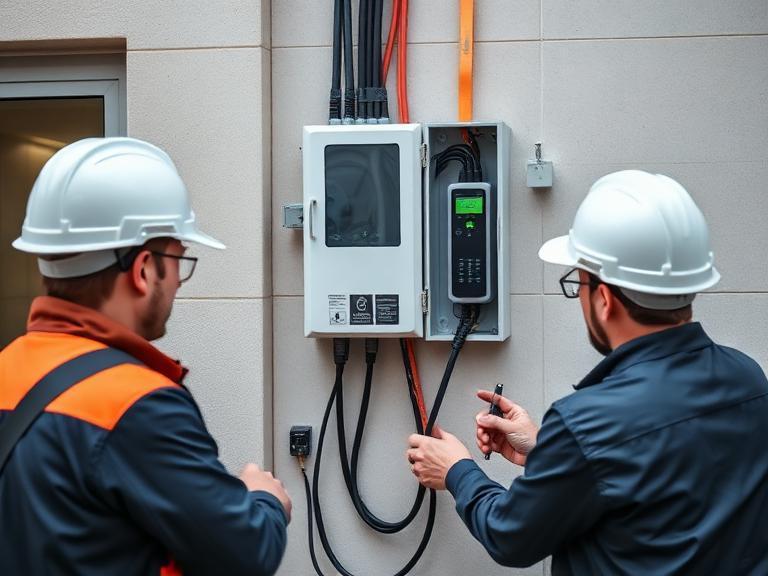
Why Commercial DC Fast Chargers Require Specialized Maintenance
Unlike standard AC wallboxes, DC fast chargers function as industrial-grade power transformation sub-stations. Maintaining these systems requires advanced high-voltage diagnostic tools, thermal imaging, and certified power electronics engineers.
Key Factors Impacting DCFC Hardware in Hyderabad:
- Extreme Heat & Power Module Throttling: DC fast chargers use modular 15 kW, 20 kW, or 30 kW switch-mode power supply (SMPS) conversion units. When ambient air in areas like Gachibowli or Madhapur exceeds 40°C, cooling fans struggle to dissipate heat. Dust-choked intake filters cause internal temperatures to spike above 85°C, triggering automatic current throttling or full shutdown.
- High Current Arc Wear on DC Contactors: Switching hundreds of amperes of direct current causes electrical arcing across internal DC contactor tips. Over time, this wear causes contactor pitting, increased resistance, local overheating, and contactor welding.
- Insulation Resistance & Earth Faults: Intense monsoon rain causes moisture to build up in cabinet bases and cable connector heads. Insulation resistance (IR) drops below required safety thresholds (under 500 ohms/volt), triggering immediate ground-fault isolation trips.
- Wear on CCS2 and CHAdeMO Cable Guns: Heavy public use leads to dropped connector guns, broken latch mechanisms, worn temperature sensors (PT100/PT1000), and bent pin connectors, causing handshake failures with electric vehicles.
Scope of Our DC Fast Charger O&M Services
Our Operations and Maintenance (O&M) programs cover every subsystem within high-power DC fast-charging terminals:
1. Power Electronics & Cabinet Diagnostics
- Power Module Performance Audits: Balancing load across parallel power modules, measuring conversion efficiency, testing output voltage ripple, and replacing failing rectifiers or SiC MOSFET modules.
- Busbar & Connection Thermography: Infrared thermal scans of main AC inputs, DC output busbars, fuse blocks, and heavy-duty contactors under full 100% load to catch high-resistance hot spots.
- Auxiliary Power Supply (APS) Checks: Testing internal 12V/24V DC auxiliary power supplies that drive control electronics, display panels, and emergency safety circuits.
2. High-Voltage Safety & Grounding Controls
- Insulation Resistance Megger Testing: Performing 1000V DC insulation tests across high-voltage buses to ensure line-to-ground isolation remains completely intact.
- Surge Protection & Breaker Calibration: Testing primary and secondary Surge Protection Devices (SPDs), verifying high-rupturing capacity (HRC) fuses, and testing shunt-trip main MCCBs.
- Earth Pit Impedance Verification: Measuring dedicated earth pit resistance to ensure ground bonding remains under 2 Ohms, protecting users against stray currents.
3. Cable, Gun & Cooling Subsystem Servicing
- Cable Strain Relief & Pin Polishing: Polishing high-amperage power pins, replacing worn DC connector shells, and adjusting internal tension cables on cable retractors.
- Liquid Cooling Loop Maintenance: Inspecting coolant pumps, verifying glycol fluid levels, flushing heat exchangers, and checking pressure sensors on high-output 250 kW+ liquid-cooled guns.
- Filter & Air Circulation Overhaul: Cleaning or replacing washable cabinet air filters, clearing intake louvers, and balancing high-CFM exhaust fan arrays.
4. OCPP Firmware, Payment Gateway & Network Health
- OCPP Protocol Synchronization: Diagnosing OCPP 1.6J and 2.0.1 communication logs, resolving message queuing errors, and syncing transaction data with central management servers (CMS).
- EV-to-Charger ISO 15118 / DIN 70121 Handshake Audits: Resolving Power Line Communication (PLC) board signal drops during initial vehicle pairing.
DC Fast Charger Maintenance Classifications
| Maintenance Type | Operations Performed | Inspection Interval | Ideal For |
| Preventive Maintenance (PM) | Cabinet cleaning, filter swaps, thermography, bolt torque checks, safety trip testing. | Monthly / Bi-Monthly | All commercial public & fleet DC fast chargers. |
| Corrective Maintenance (CM) | Module replacement, contactor swaps, cable gun repair, main controller board re-flashing. | On-Demand / SLA Event | Unexpected hardware trips, vehicle handshake failures. |
| Predictive Maintenance (PdM) | CMS telemetry analysis, fan RPM tracking, module temperature trend monitoring. | Continuous (Remote) | High-utilization highway & fleet depot chargers. |
| Overhaul Maintenance (OM) | Full cabinet rewiring, liquid-coolant system flush, power module bank re-calibration. | Annual / Bi-Annual | Chargers operating over 18 hours per day. |
Operational Workflows: Breakdown Diagnostics & Repair
[Fault Reported via CMS or Site Audit]
                  │
                  ▼
[30-Minute Remote Engineering Triage]
  • Analyze OCPP status logs & DC controller error codes
  • Execute remote soft-reset / firmware verification
                  │
                  ▼
[On-Site Field Engineer Dispatch (2-4 Hour SLA)]
  • Mobile service unit equipped with DC modules & spare cables
  • Lockout/Tagout (LOTO) safety protocol execution
                  │
                  ▼
[Component-Level Testing & Repair]
  • Megger insulation check & thermal imaging scan
  • Hot-swap failed power modules, contactors, or PLC board
                  │
                  ▼
[Full-Load Validation & Calibration]
  • Testing real-world session using high-capacity DC load bank or EV
  • Verify communication handshake & power delivery curves
                  │
                  ▼
[Site Sign-Off & CMS Telemetry Reset]
  • Submit digital O&M report and close service ticket
Strategic Service Coverage Across Hyderabad
Our field engineering response teams cover all strategic regions within the Hyderabad Metropolitan Development Authority (HMDA) limits:
- Cyberabad Tech Corridor: HITEC City, Gachibowli, Kondapur, Madhapur, Financial District, Raidurg, Kokapet, Nanakramguda.
- Logistics & Fleet Depots: Shamshabad Airport Zone, Patancheru, Medchal, Cherlapally, Uppal, Jeedimetla, Balanagar, Kattedan, Auto Nagar.
- Commercial & Transport Hubs: Begumpet, Secunderabad, Banjara Hills, Jubilee Hills, Kukatpally, Miyapur, LB Nagar, Ameerpet, Mehdipatnam.
- Key Highway & Expressway Arteries: Outer Ring Road (ORR) Interchanges, NH 65 (Hyderabad-Vijayawada), NH 44 (Hyderabad-Bengaluru), NH 163 (Hyderabad-Warangal).
Multi-Manufacturer DC Fast Charger Support
Our engineering team maintains multi-brand diagnostic software and stock spare components for major global and domestic DCFC manufacturers:
- Public & Highway DC Hardware: Delta Electronics (City Charger / Ultra Fast), Exicom (Harmony DC Series), ABB (Terra Series), Siemens (Sicharge D), Mass-Tech, Trinity Touch, Servotech, Relux, Quench, and EVRE.
- Fleet Depots & Bus Chargers: Electra EV, Kirloskar, Morse, and specialized pantograph / plug-in depot chargers for commercial electric buses and commercial vehicle fleets.
Frequently Asked Questions (15 FAQs)
Q1: What is included in a DC Fast Charger Maintenance contract in Hyderabad?
Answer: A comprehensive DC Fast Charger Maintenance contract covers monthly or quarterly preventive audits, 24/7 CMS remote monitoring, thermal imaging scans, cabinet filter replacements, cable and connector maintenance, high-voltage insulation tests, emergency breakdown repairs, and software optimization.
Q2: Why do DC fast chargers trip more frequently during Hyderabad summers?
Answer: Summer temperatures in Hyderabad frequently exceed 40°C. Under high current output, internal DC fast charger components reach thermal limits. If cooling filters are clogged with dust, exhaust fans cannot cool the switch-mode power modules, triggering auto-protective thermal shutdowns or power throttling.
Q3: How quickly can an engineer respond to an off-line DC fast charger?
Answer: Critical SLA contracts guarantee on-site dispatch of a certified high-voltage field engineer within 2 to 4 hours across Hyderabad metropolitan limits. Remote telemetry diagnostics begin within 30 minutes of fault detection.
Q4: What are the main causes of CCS2 gun failure on DC chargers?
Answer: Physical damage from dropping connector heads onto concrete, pin oxidation caused by monsoon moisture, mechanical wear on top latch mechanisms, and overheating of internal DC contact pins due to high resistance are the leading causes of CCS2 gun failure.
Q5: Can degraded DC power modules be repaired on-site, or must they be replaced?
Answer: Faulty power modules are typically hot-swapped on-site with a calibrated replacement unit to restore immediate service. The damaged module is then transferred to our lab facility for component-level repair, such as replacing blown capacitors, control boards, or SiC switches.
Q6: How does insulation resistance affect DC charger operation?
Answer: DC fast chargers operate at voltages up to 1000V. If moisture or dust lowers internal insulation resistance below safety thresholds (typically under 500 ohms/volt), the system trips its isolation monitor to prevent electrical shocks and cabinet shorts.
Q7: What is the typical lifespan of a commercial DC Fast Charger in Hyderabad?
Answer: With structured preventive maintenance, a commercial DC fast charger lasts 8 to 10 years. Without regular servicing, dust buildup, thermal stress, and power spikes can cause critical module failures within 2 to 3 years.
Q8: How often should DC charger cabinet air filters be replaced in industrial areas like Jeedimetla or Balanagar?
Answer: In dusty or industrial zones, intake air filters should be inspected monthly and washed or replaced every 60 to 90 days to maintain proper airflow and prevent overheating.
Q9: What is the difference between AC charger maintenance and DC fast charger maintenance?
Answer: AC charger maintenance focuses on input AC distribution, basic contactors, RCD safety, and cable integrity. DC fast charger maintenance involves servicing complex high-power AC-to-DC rectification systems, high-voltage liquid cooling loops, active power modules, power factor correction (PFC) stages, and PLC communication interfaces.
Q10: Do you provide maintenance support for electric bus and commercial fleet DC chargers?
Answer: Yes. We provide specialized O&M services for high-capacity fleet charging depots, supporting dual-gun 120 kW to 240 kW DC stations and pantograph charging systems with overnight and off-peak service options.
Q11: How do you resolve EV-to-charger connection handshake errors (ISO 15118 / DIN 70121)?
Answer: Handshake errors stem from Power Line Communication (PLC) board signal attenuation, outdated controller firmware, or worn connector pins. Our technicians inspect signal lines with oscilloscopes, update controller firmware, and replace damaged pin assemblies on-site.
Q12: Are replacement parts included under DC Fast Charger Maintenance contracts?
Answer: Comprehensive maintenance contracts include routine consumable spares like filters, fuses, SPDs, internal cables, and switches. Major power modules, main control PCBA boards, and liquid-cooled cables can be included under full-risk plans or supplied at fixed pricing.
Q13: Why is thermography testing essential during DC charger servicing?
Answer: Thermal imaging identifies loose terminal connections, corroded busbars, and overheating contactors under real-world load before they burn out wires or cause fire hazards.
Q14: How does earthing quality impact DC fast charger performance?
Answer: Poor earthing causes ground potential shifts, triggering safety isolation trips, corrupting CAN-bus data, and causing communication drops between the charger and central backend servers. Ground resistance must be regularly checked and kept under 2 Ohms.
Q15: How can charging site operators schedule an O&M audit in Hyderabad?
Answer: Site operators can contact our engineering team to request a diagnostic audit. We perform a full baseline evaluation of electrical safety, thermal profiles, and internal module health, delivering a custom maintenance program for your site.
Leave a Reply